Posts in category "blogging"

why Reddit is useless for bloggers

Yesterday was 1 December and an innocuous post on identi.ca about an Advent calendar immediately reminded me of an amusing (and completely true) blog post I wrote two years ago.

This, in turn, prompted me to write this short note on identi.ca and the post on identi.ca subsequently appeared on my FriendFeed stream.

Normally, when I post a new blog entry, the post gets visited by a handful of people - presumably a subset of those subscribed to this blog. In this case, this wasn't a new post so regular RSS readers wouldn't see this content so any visitors had to come from identi.ca or FriendFeed.

Despite having over 150 subscribers on identi.ca and 21 'friends' on FriendFeed, only a couple of people clicked through to the 'eat your own dog food' post when it appeared on identi.ca and FriendFeed. This isn't unusual (for me, at least) - the same pattern happens with any new blog content.

My very good friend and Oracle colleague, the right honourable Emperor of Ontario (possible pseudonym alert) had recently signed up to reddit.com and was curious about the viral effect of reddit and how it might be used to help generate traffic to a blog.

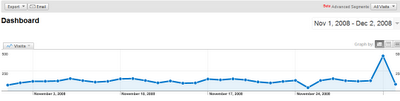
Ontario Emperor kindly submitted my humble blog post to Reddit under the category 'Funny'. When I became aware of this, I monitored the Web server logs and immediately saw a lot of traffic generated from reddit. At one point, the post reached No. 15 on Reddit's 'Funny' page and 6 people 'liked' the entry.

Reddit-Spike

The traffic spike was short lived (similar pattern to getting a post on StumbleUpon). However, although the increase in traffic is interesting and briefly satisfying, it is really not that useful for a blogger because:

  • Reddit generated visitors are almost always 'one-hit wonders'. They visit one page and immediately leave.
  • Reddit generated visitors are unlikely to linger on the site and explore other content.
  • Reddit generated visitors are unlikely to comment and resurrect conversation over a two year old post.
  • Reddit generated visitors are unlikely to subscribe to your blog.
  • Reddit generated visitors are all new visitors to your blog. Consequently, they don't understand the context, the author, the history, the sense of humour or the writing style.

As a brilliant example of the last point, a solitary comment was left on the blog post by a Reddit visitor. The comment was so superlative, so funny, so brilliant, I have chosen to reproduce it here in all its glory to save you all the trouble of a time-consuming, pesky mouse click.

why r u so cruel to your own children?

can u not be a little more sympathetic?

You shouldn't need to explain yourself. You shouldn't have to put sign posts up everywhere. You shouldn't feel obliged to use the tag 'Humour'. You shouldn't need to insert a plethora of emoticons just for passing ~~visitors~~ idiots.

And that is why Reddit is completely useless to bloggers.

evangelism - Habari style

Dear Prudence

Thats excellent news. I am glad to hear you have managed to get PDO installed and now have Habari up and running on your site.

As for how I happened to stumble across your site, well....

There's an army of committed, passionate Habari enthusiasts who routinely conduct Twitter, Web and blog searches for every single mention of the word 'Habari'.

In addition, one of the primary responsibilities of the mysterious organisation - the Cabal - is to infiltrate Government intelligence agencies worldwide (GCHQ, NSA, Mossad, KGB) and access transcripts of all mobile phone conversations and SMS text messages. Sophisticated AI algorithms (grep with regular expressions) are then used to mine that data, searching for Habari related terms.

Then whenever we identify anyone using Habari, we leave a 'Welcome to Habari. Enjoy the ride' comment on the blog.

If people are having problems, we desperately marshall all available technical resources try to assist and claw them back from the abyss.

And if we discover individuals who have tried, failed, given up in disgust and gone back to Drupal, Joomla or WordPress, well we pay them a personal visit and shoot them :-)

Peace, love, empathy

The Habari Evangelist.

more fun with keyword searches

The gift that simply keeps on giving.

  • '914 scam' - if you don't know the correct name, you may already be doomed to failure.
  • 'reasons for isolation' - spending too much time on the Internet searching for 'reasons for isolation'.
  • "craig gordon" "ian curtis" - odd combination of a dead pop star and a living Sunderland goalkeeper.
  • 'my wife's shapely legs' - yeah right. Take those stockings off. Now.
  • "("current vacancy" or vacancies or opportunity or careers or "working with" or "working for") and ("oracle dba" or oracle dba )and london" - with such a superlative grasp of search term syntax and semantics, you would simply be wasted as an Oracle DBA.
  • 'dead bodies in the floor boards' - stop it. You are worrying me with the use of 'in' as opposed to 'under'.
  • 'how to become a virgin again' - Please sit down. Have a drink. I have some bad news for you.
  • 'ian curtis hanged ice block' - Look I've already told you twice This is an urban myth.
  • 'make friends under 14 to 16' - try Facebook or Beebo. Just don't get caught.
  • 'oracle killed siebel' - Mr. Ellison with the lead piping in the library.
  • 'selling strategy of siebel system anatomy' - yet another reason I don't work in sales.
  • 'the most important decision of my entire life' - undoubtedly left disappointed at my lack of insight.
  • 'urinal pulled his zipper down' - yet another reason I always favour a private cubicle.
  • 'why durex gossamer withdrawn' - apparently on the advice of the Pope.

review of Habari 0.5

Introduction

Habari is a blogging platform, created back in January 2007 and in the subsequent 18 months, the software has matured and version 0.5.1 was recently released.

Originally, I downloaded and experimented with Habari late in 2007 but it wasn't until February 2008 that I finally took the plunge and migrated my blog from WordPress.

Installation

Habari requires PHP 5.2 (or higher) and PHP Data Objects (PDO). If your hosting company can't meet these requirements, think about switching to one that can. Habari also supports multiple database types:

Installation is very simple. You simply create the appropriate database, enter the details of the database configuration together with the user credentials for the administration account.
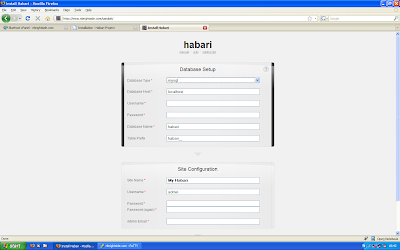
Habari-Install-mySql

Hit 'Submit' and you're finished.

Habari-Success

The Habari interface

Habari has a single menu structure and the main dashboard is fully configurable. For example, if you don't want to see 'Latest Log Activity' simply remove that tab. You can also drag and drop elements to position the various elements of the dashboard to suit yourself.
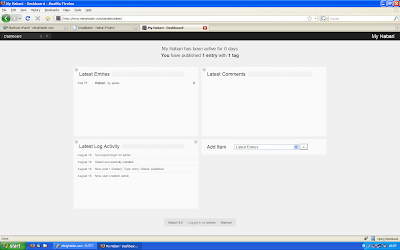
Habari-dashboard

Obviously, bloggers spend most of their time composing posts and the Habari article editor is beautifully simple, clean and uncluttered.
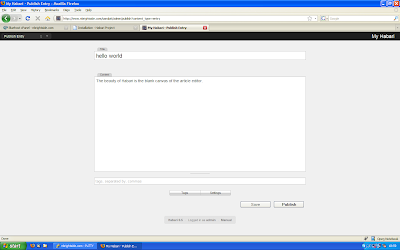
Habari-Editor

There are two separate tabs which expand to reveal the basic configuration options (timestamp, slug, comments) and another to define and add tags to the newly created post.

Searching for content in Habari is also refreshingly different. There is a timeline which can be dragged and resized, for example to focus on all posts made during 2007, supplemented by conventional searching.
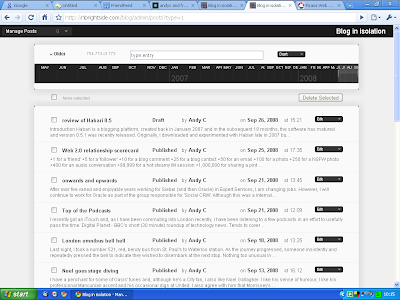
Habari-Timeline

Migration

Importers exist to import WordPress and Serendipity data into Habari. There is no native support for the (non standard) WXR format favoured by WordPress.com but staging the content into a local WordPress installation and then into Habari is possible.
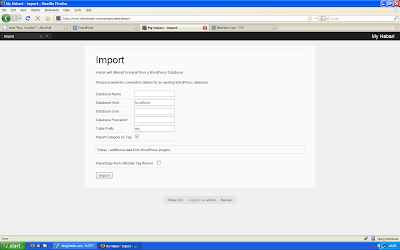
Habari-WP-Import

The WordPress importer is fast and robust. I imported over 700 posts and 1,000 comments without errors in less than 2 minutes. In fact, it was so fast, I had to double-check that the import had actually worked ! All my existing WordPress categories were correctly converted to tags.

Themes

Habari is still a relatively young project (albeit growing rapidly) so the number of themes available for Habari isn't as wide ranging as, say Wordpress. Nor is there a browsable theme directory. However, there is an increasing number of attractive, well designed themes available.
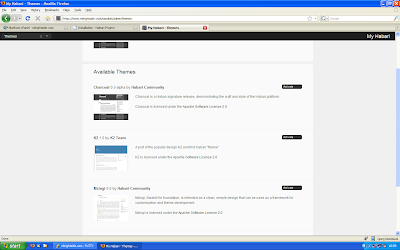
Habari-Themes

Plugins

Plugins are installed by uploading the to server and unpacking in the '/user/plugins' directory. Then the plugin is then activated and configured from the Administration-Plugins screen.
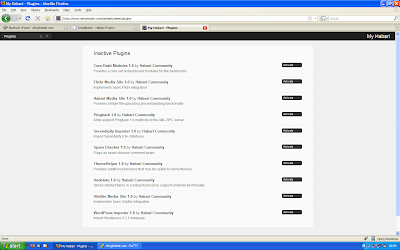
Habari-Plugins

Like themes, the number of plugins available for Habari is nowhere near as vast (or overwhelming) as other longer established blogging platforms. You can review the list of plugins in the Habari-extras repository.

However, the key functionality that most bloggers want and need are all supported. Hardly surprisingly, as all the Habari developers eat their own dog food and maintain Habari powered blogs.

  • metaWeblog - enable blogging clients like ScribeFire
  • Contact form
  • Google Analytics
  • Adsense
  • Feedburner
  • Scheduled posts
  • LiveHelp - easy access to IRC embedded in Habari
  • Defensio - superior anti-spam solution
  • Media silos for Flickr, Viddler and YouTube
  • Sitemaps
  • Podcast
  • Related Posts
  • Plugins to integrate Diigo, Jaiku, Twitter into your blog

There are also a couple of WYSIWYG editors to choose from (NicEdit, jwysiwyg) although I now use the excellent MarkUp plugin which adds shortcuts for common tags to the article editor but leaves you in full control of the HTML.

Documentation

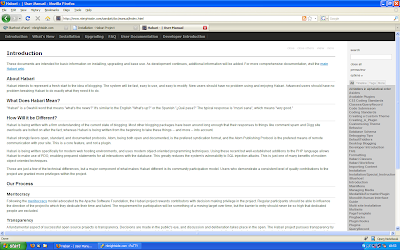
The Habari documentation is available in Wiki format. The release documentation is also distilled into TiddlyWiki and is included with the Habari distribution. This is useful if you are working in a disconnected environment.
Habari-Manual

Why is Habari different ?

People often ask 'What makes Habari better than XYZ ?' And, of course, that's hard to answer and also very subjective. I always reply; 'Habari isn't better - it's just different'.

Having used the software for six months now, these are a few of the reasons I like Habari:

  • Ease of use.
  • Admin interface.
  • Media silos.
  • Actively developed.
  • The 'community'.
  • The article editor.
  • Ease of use
  • Small, active and responsive developer community.
  • The automatic schema upgrade process works seamlessly.
  • The LiveHelp plugin.
  • Proper timezone support built into core.
  • Minor edits - ability to fix typos without updating the Atom feed.
  • Ease of use.

And finally, and perhaps most importantly - Habari is fun - the project is developing rapidly. It's fun to run the latest SVN code. It's fun to review the latest set of changes in trac. It's exciting to type 'svn update'. It's fun to lurk in the IRC channel and eavesdrop on developer discussions.

Of course, there are some areas of functionality (access control lists) that are incomplete or 'planned' but I can honestly say that the absence of the following features doesn't really affect my normal, daily use of Habari.

  • No Fantastico or SimpleScripts installations available.
  • No centralised theme or plugin repository.
  • No widget support - you currently have to modify PHP templates to modify your sidebar.
  • No automatic upgrade of core software, themes or plugins.
  • Tags are supported but not categories.
  • The plugin configuration forms are pretty basic.
  • Documentation for plugins is sparse.

Community

The word 'community' is used a lot in the Habari community. I think it's because those guys like recursion. Before I got involved, I was fairly sceptical to be honest. However, having lurked, watched from the sidelines and occasionally contributed, I can say that there is a genuine sense of community on the Habari project. Contributions from anyone and everyone are positively welcomed and encouraged. There's a couple of mailing lists, an IRC channel, a Wiki and subversion repository.

As just one example, I was staggered when I was initially playing with Habari and mentioned in passing that the lack of a WYSIWYG editor was an issue. Within 12 hours, Michael Harris had provided me with a TinyMCE plugin !

Although I'm not a expert Web developer - I can't spell PHP or OO - I must say, that everyone has been very helpful. There is no elitist developer clique - Habari is very transparent and open and everyone's contribution (no matter how seemingly small) is welcomed.

Once awake, Habari developers can also move fast. For example, yesterday, the Cisco Web site was hacked and every single occurrence of the letter 't' was lost. By the end of the day, Habari had a hilarious plugin that also filtered every single 't' from a Habari blog.

Summary

Don't take my word for it. Why not download Habari and try it for yourself ? You might be surprised.
Web 2.0 relationship scorecard

  • +1 for a friend
  • +5 for a follower
  • +10 for a blog comment
  • +25 for a blog contact
  • +50 for an email
  • +100 for a photo
  • +250 for a NSFW photo
  • +400 for an audio conversation
  • +99,999 for a hot steamy IM session
  • +1,000,000 for sharing a pint

twitter killed the blogging star

I have tried many times, in many different places, to articluate the idea that micro-blogging reduces ones blogging output but Russell Beattie completely expresses my thoughts on the subject in this brilliant article.

'Tweeting totally takes away that blogging urge from me... Once I tweet about something, it's like it disappears from my mind completely.'

I can completely identify with this statement and another sentence also struck a resounding chord with me:

'Tweets have no archival value of any sort'

I think this is so true. Occasionally, I may dig up an old blog post to refer to. Why sometimes, in a lonely hotel room, I may even just scan my blog archives - just for my own enjoyment.

However, I never, ever revisit any of my inane drivel posted on Twitter, Jaiku or even identi.ca. As I once (apparently) remarked to Michael...

I used to enjoy blogging a lot more and I actually have a couple of humourous blog articles that I am genuinely quite fond - no more than that - proud of.

Twitter is just the ultimate in 'disposable' blogging. All that crap posted from Heathrow T5 just fills my time in. It's hardly earth shattering, is it ? God - I can't remember any of those stupid tweets (apart from the lads in Yellow Lurex suits that was pretty funny) let alone be proud of all those throwaway one-liners.

That's not to say micro-blogging doesn't have a place or isn't valuable, merely that proper, grown up blogging has more value and longevity which makes perfect sense. The more you put in, the more you get out.

knowing me, knowing you

[ This post also had working titles of Friends, bloggers and countrymen and anti-social networking. ]

A few weeks ago, a gentleman called WaveyDavey001 was kind enough to invite me to participate in a Fantasy Football League.

Rather rudely, I attempted to invite several of my friends into the same League so I only needed to manage one team. WaveyDavey001 politely agreed with the caveat; 'I'd like to vaguely know most (of them)'.

This innocuous, throwaway comment started me thinking about the nature of relationships on all these social networks.

WaveyDavey001 only 'knows' me from Jaiku. He knows I support Manchester United and knows I like football. Therefore, just like any clever marketeer, he knew it was possible I might be interested in a Fantasy League.

The only biographical details I have published on Jaiku are that I am from 'London, near England'. I also publish an avatar on all social networks but this is merely a picture of Alan Partridge dressed up as a drug crazed zombie, caked in flour. This often leads to disappointment when people meet me in the flesh.

If you followed my various online presences for a period of time and/or trawled through the archives, you could probably gather lots more information about me (where I live, who I work for, my age, my marital status, my full name) but that would just make you a stalker and I could get a restraining order.

Now Michael C Harris maintains that every single utterance on Jaiku, Twitter, identi.ca, FriendFeed (et al) is divulging information about me - my interests (football, music, tennis, software, blogging etc), my attitude, my sense of, err, humour, and, of course, he's absolutely right. Michael sums it up succinctly in this related post: 'The body of tweets is indicative.'

I have encountered various, interesting, humourous, friendly, helpful people since I started blogging three years ago and yet I still really struggle with what to call these people - friends, mates or blogging acquaintances.

A long time ago, one of my earliest and longest standing blogging acquaintances, engtech, made a comment on a blog where he referred to me as a 'friend' and I was genuinely quite taken aback.

I have never met most of my 'blogging acquaintances' in person. I haven't spoken with most of my 'blogging acquaintances'. I don't know what most of my 'blogging acquaintances' actually look like.

To me, a friend is someone you have met in person and shared a pint with. A friend is someone you could rely on.

I suspect the social networking equivalent of 'sharing a pint' would probably be Instant Messaging. Most of my relationships start with comments on blogs and may subsequently develop into email contact and occasionally conversations on IM.

And the point of all this ? Well - I'm not too sure but this post has been gathering dust in the dark recesses of my mind and hogging an entry in 'Drafts' for far too long. Plus the Partridge-esque title was simply too good to resist.

What do you call your blogging acquaintances ? Is my attitude to 'friends' simply typical British self-reserve ? Or am I a tortured soul prone to over analysis and introspection ?

in praise of Disqus

Disqus recently released a update which includes the ability to export comments on a WordPress blog so I have just exported all historic comments left on this blog (when it was running WordPress) into Disqus.

This operation was slightly complicated because this blog now uses Habari but the necessary steps were:

  1. Download and install the new Disqus 2.0 plugin for Wordpress.
  2. Delete all obvious spam so the export only processes genuine comments and runs faster.
  3. Switch the archived WordPress copy of the blog back to the original location.
  4. Export all comments from WordPress into Disqus.
  5. Claim comments left by myself using an alternative email address before I had even heard about Disqus.
  6. Wrap the WordPress blog in cling-film, label and place back into cryogenic storage.
  7. Reinstate the Habari blog.

However, because I am pretty stupid and overly hasty, inevitably I omitted step 3. This meant that while all comments appeared on the Disqus site, the permalinks to the individual blog articles were incorrect and referenced '/wordpress/' instead of '/blog/'.

As it wasn't obvious how to rectify this issue or perform a selective bulk delete so I could repeat the process, I sent an email to Disqus support explaining the problem and asking for help.

24 minutes later, Jason from Disqus emailed me saying he'd fixed all the URL's.

What a fantastic service. What a fantastic product. What fantastic people.

So now I can put the kettle on and reaquaint myself with 886 comments (including some old friends) that have now been restored to their rightful place.

The only gap that remains is that a relatively small number of comments left on my blog after the Habari migration and prior to the adoption of Disqus are not currently visible. Hopefully, when the Disqus API is fully released, even this may be possible.

reader fragmentation

I suspect I have different audiences reading my blog, Tumblr, Friendfeed, Jaiku, GR Shared Items. I call this reader fragmentation but havent applied for copyright yet. Should I ?

pocket Web 2.0 dictionary

Define your favourite Web 2.0 service in two words (or less)

  • Blogging: Dear diary
  • Flickr: Cat photos
  • FriendFeed: 'Friend's Feeds'
  • Tumblr: 'Disposable blogging'
  • Wikipedia: 'Online encyclopedia'
  • Twitter: 'Inane drivel'
  • del.icio.us: 'Period overload'
  • Disqus: 'Modern flamewars'
  • Digg: 'Technical narcissism'
  • Last.fm: 'Dire Straits'
  • YouTube: 'Cat videos'
  • LinkedIn: 'Gizza job'