Posts in category "blogging"

new look for monthly archives

There is a new, improved Monthly Archives plugin available for Habari which is now installed on this blog.

I realise that I'm probably the only person to ever scan the historical archives but I really like it so, once again, many thanks to Chris Meller and the Habari community.

Unified Blogging Day

Many disgruntled readers have contacted me via email, IM, facsimile, phone and anonymous poison pen letters to ask Hey Norman - whatever happened to the unified blogging day scheduled for Friday 18 April ?

Apologies for the delay but before we get started, some random, meaningless statistics:

  • Feedburner: 66 subscribers.
  • Google Reader : 'From your 189 subscriptions, over the last 30 days you read 6,807 items, starred 1 items, shared 325 items'.
  • Twitter: Following 19. Followers 55. Updates 1,292 in 87 days.
  • FriendFeed: Subscribed to 35. Subscribed to me: 30. Comments: 180 this week, 504 all time. Likes: 77 this week, 188 all time.
  • Disqus: Comments left: 59 in 21 days. Comments on my blog: 31 in 14 days. Precious clout points - 12.

Originally, on Unified Blogging Day, I was going to religiously transcribe every single 'output' over a 24 hour period into a separate blog entry (annotated with timestamp and channel).

This was primarily a final effort to alienate loyal (but shell-shocked) readers who had survived the WordPress to Habari migration.

However, thankfully, FriendFeed already aggregates that inane stream of consciousness beautifully formatted here.

A secondary aim of Unified Blogging Day was to conduct a detailed poll to see how people subscribe to each 'output' but Habari doesn't have a 'Poll' plugin so just leave a comment below indicating which channel(s) you are a) aware of, b) subscribe to c) devour feverishly and d) blissfully unaware of.

  • Blog - a man barely alive but we have the technology to rebuild him.
  • Tumblr - stuff I'm too embarassed to put on the blog.
  • Technical blog - low traffic.
  • Twitter - endless stream of drivel (soon to be upgraded to include 'Hello', Goodnight' and the state of my runny nose).
  • Disqus - every single comment I have left on the blogoshpere (on Disqus enabled blogs).
  • FriendFeed - unified feed of all of the above. Filters available to reduce the signal/noise ratio.

Anyone owning up to subscribing to duplicate channels will have stay behind after school for 1 hours detention (unless they have a note from Mummy).

the thorny issue of blog comment ownership

A couple of Oracle bloggers (Laurent and Yas) are experimenting with Disqus on their blogs but Tim Hall has expressed some reservations about committing his blog comments to a hosted service outside of his control.

Jake Mckee is also taken by Disqus but eloquently expresses similar concerns about 'data ownership and presentation'.

I understand (and used to vehemently share) both Tim and Jake's reservations. It does seem perfectly natural to want all your blog content stored in your MySql database on your server. What if Disqus servers are slow and unresponsive or worse, even down ? Your blog would be accessible but your comments wouldn't. What is Disqus isn't around next year ?

How do you unlock your comments from the Disqus repository and migrate them back into your blog ? How do you backup your comments ? There is an export utility but, as Jake points out, currently no easy way to import the data back into the blog.

Having comments hosted on your own blog is entirely logical. Obviously, blog comments belong with the blog content. Without the associated comments, the blog is like a half-written book.

You manage the blog comments. You back them up. You moderate them. The blog comments obviously belong to you. All of them. Yes - even those 1,729 spam comments, you have to scan for the odd 'false positive'.

However, if I leave a comment on a Harry's disqus enabled blog, my comment is displayed on the original blog. The comment text that I typed in is no longer stored in Harry's database table for 'comments'. Worse, my comment is now simultaneously displayed on a Disqus community forum without my prior knowledge or approval.

But who actually owns that comment on Harry's blog. I thought of the words and typed them into the comment box. Do I own the comment ? Or does Harry ? Does it even matter ?

As an aside, having used the service for a week, I no longer view Disqus purely as a comment tracking service. I view Disqus as a 'content output' tracking service.

For example, I am now starting to ask idiotic questions and log issues on the Disqus forums. These posts are not clearly not comments (but original content) but I still want to track them (and, more importantly, responses to them) in my Disqus dashboard alongside my blog comments.

25 reasons you should use Disqus

  1. Disqus lets you easily track all comments you have left scattered over the blogosphere.
  2. Disqus allows you to administer comments on multiple blogs from a single dashboard.
  3. Disqus has built-in effective protection against comment spam.
  4. Disqus provides tight integration with Blogger, WordPress, Typepad, MT and Tumblr.
  5. Disqus provides Javascript code for every other CMS.
  6. Disqus supports threaded comments.
  7. Disqus allows you to fix that embarrassing typo by editing comments.
  8. Disqus β€˜eat their own dog food’.
  9. Disqus is free to use. 10.Disqus is used on over 4,000 blogs.
  10. Disqus lets you subscribe to individual comment threads.
  11. Disqus supports gravatars.
  12. Disqus lets you rate comments you like (and dislike).
  13. Disqus provides an RSS feed for all your comments.
  14. Disqus styles comments in keeping with your blog.
  15. Disqus is configurable and extensible.
  16. Disqus is written in Django.
  17. Disqus treats an email reply to an comment thread as as additional comment.
  18. Disqus is under active development.
  19. Disqus listen to user feedback.
  20. Disqus offers an API so you can write your own applications.
  21. Disqus allows you to use your OpenId credentials.
  22. Disqus offer unbelievably helpful and prompt support.
  23. Disqus provide excellent widgets.
  24. Disqus supports multiple moderators and a range of moderation options.

resurrection of Disqus comments

Five months ago, I experimented with Disqus powered comments when this blog was running on WordPress. The trial was rather short-lived because I was disappointed that Disqus wasn't able to fully integrate with all the existing blog comments. Importing comments still isn't possible but Disqus says this feature is being worked on.

However, I have decided to reinstate Disqus for the following reasons:

  • Disqus recently added integration with FriendFeed so any contributions I make on Disqus powered blogs will also be visible in my FriendFeed stream.
  • I am encountering an ever increasing number of blogs using Disqus.
  • I am hoping Disqus will help to trigger more comments, interest and interaction on the blog.
  • Disqus provide a nice combination widget providing 'Popular', 'Recent Comments' and 'People'.
  • The most recent release of Disqus included a raft of changes including support for Open ID.
  • Disqus is being actively developed and, more importantly, listen to their users.

I still have some reservations that the couple of articles with decent comment threads included replies to earlier comments (which are no longer visible) so we are literally starting from zero. However, hopefully some comments will appear soon and the tabs will actually display something !

Aside: Unfortunately, adopting Disqus means I will no longer be using Matt Read's recently released Defensio plugin which is excellent and highly recommended for any Habari bloggers wading through a torrent of comment spam.

blogging bankruptcy

Its no good. I simply cant go on. I can no longer summon up the enthusiasm for blogging.

All the warnings from the blogging 101 courses over the years have proven to be very true.

I foolishly dipped my toe into Twitter and then FriendFeed but it's no good I simply can't go on with this any longer.

I can't bear to miss my children growing up just because 'Facebook is so last year, Dad.'

I can't bear to talk to my wife and be abrupt and terse simply because I am now limited to 140 characters.

The time has finally come for me to declare complete 100%, unadulterated blogging and Web 2.0 bankruptcy.

Thank you all from the pit of my burning, nauseous stomach for your comments during the past years.

Tomorrow I will resign from Oracle Corporation and will devote the rest of my life to my one true love.

Learning to play guitar well enough to cover 'Country Feedback' by R.E.M. Wish me luck.

Peace, love, empathy

The byte stream that is 'Blog in Isolation'.

WordPress 2.5 dashboard

The forthcoming release of WordPress 2.5 was one reason I was hesitant to move to Habari.

However, having seen a demo of the revised dashboard in WordPress 2.5, all I can say is I am glad I made the move and didn't wait.

While I am merely an end user (not a UI designer), Michael Heilemann articulates many of my views on the deficiencies and usability of the Wordpress dashboard in this detailed analysis.

Michael also dissects the design of the WordPress 'Write Page' screen. The 'Write Page' is probably the most important one for the blog author as that's where he spends most of his time. I agree with Michael - the page is cluttered with unnecessary distractions

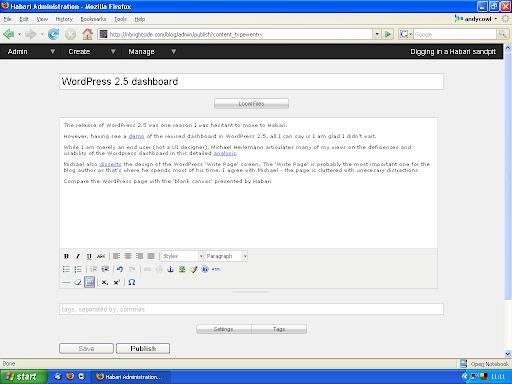
Compare the WordPress page with the 'blank canvas' presented by the article editor in Habari.

Habari Blank Canvas

post mortem on the WordPress to Habari migration

Those who forget the past are condemned to relive it.

The migration of this blog from WordPress to Habari is mostly complete.

I had a few unexpected problems with a significant number of comments and a handful of posts that contained mismatched HTML tags and didn't display the corresponding page at all. So I had to painstakingly review every single post with comments and correct the HTML by hand.

Inevitably, I forgot the lesson of my previous migration and didn't give any regular readers advance warning of the impending chaos or any notice of the change in RSS feeds. That's not because I don't care, but rather that I treat this blog as a chance to experiment with the technology.

Worse, I didn't sever the link to Feedburner during the housekeeping so peppered existing readers with duplicate, outdated articles.

So, whether you are a (non-Feedburner) subscriber who is wondering why I have suddenly stopped blogging or an existing reader wondering I am peppering your RSS feed with antiquated articles from yesteryear, I apologise.

If I was embarking on the migration again, I would probably spend a little more time checking the migrated content prior to triumphantly making the switch. However, when you have more then 750 posts and 1100 comments, that's easier said than done.

A useful tip to speed up the import process is to purge all comment spam in WordPress prior to the import. Similarly, disabling the Habari Pingback plugin also speeds up the import considerably.

Habari does not automatically ping Google of new content but Feedburner has equivalent functionality.

Apart from fixing up a few posts containing locally hosted images, the tedious administration tasks should now be complete so I can start to enjoy the various features of Habari.

One example is the media silo with Flickr integration. On WordPress, I often struggled with the seemingly simple task of inserting a photo into a blog post. Initially, I thought I was just stupid but now I know why - the interface was broken.

Owen Winkler created a screencast demonstrating the features of the Habari media silo with easy management of locally stored images as well as seamless integration into media services (Flickr, Viddler).
now on Habari

I simply couldnt resist the temptation any longer so this blog is now running on Habari because:

  • The Habari Administration screens look like they have been designed rather than evolved.
  • The WordPress import utility works brilliantly.
  • Michael C. Harris created a TinyMCE plugin for Habari - literally minutes after my initial enquiry.
  • Most of the required functionality (Google Analytics, Feedburner, Akismet, Sitemap) is available as plugins for Habari.
  • Michael Harris also helped me configure rewrite rules so my existing WordPress permalink structure is retained.
  • A gentleman called Harry from London developed this attractive Habari theme.