Posts from October 2012

Amazon customer service

I am currently hosting this site on Amazon Simple Storage Service (S3). For the first 12 months I am eligible for the Free Usage Tier pricing.

The Free Tier isn't completely free but includes '5 GB of Amazon S3 standard storage, 20,000 Get Requests, and 2,000 Put Requests'.

Initially, I had to test, review and deploy the entire site a few times before I got things right and Google's crawler was busy re-indexing the site so I wasn't wholly surprised when September's bill was a measly 15 cents.

The breakdown was as follows:

  • S3 storage $0.01
  • GET requests $0.03
  • PUT requests $0.08
  • Tax $0.03

The only element that puzzled me was the S3 storage which is free for up to 5GB. I checked the size of the site which is just 21MB (all images are outsourced to Picasa).

$ du -sh public
21M    public

I sent an email to Amazon customer service asking for clarification - not because I can't afford a penny - but because I would like to understand the pricing structure ready for when the 12 month Free Tier period expires.

In the interim period, I found the answer on the AWS FAQ - the Free Tier assumes Standard S3 Storage will be used and I was using the following 's3cmd' to deploy my site.

    s3cmd sync --acl-public --reduced-redundancy public/* s3://#{s3_bucket}/

The choice of the Reduced Redundancy Storage option makes sense as this normally costs less ($0.093 per GB) than standard storage ($0.125 per GB) and this is a low traffic website (and I have multiple backups).

However, this caveat is actually covered in the last section of the FAQ

Does the AWS free tier include Amazon S3 Reduced Redundancy Storage (RRS)?

No, the AWS free tier does not include Amazon S3 RRS storage. The AWS free tier includes 5 GB of Amazon S3 standard storage, which offers the highest Amazon S3 durability.

A couple of days later I received a response from a Amazon Customer Service rep who confirmed that Reduced Redundancy Storage wasn't covered by the free tier, apologised for the misunderstanding and applied a $5 credit to my AWS account for the 'inconvenience caused'. For me, this will probably equate to 3 years 'free' hosting.

Once again, fantastic customer service from Amazon. I was originally thinking of investigating altenative hosting options when the 12 month period expires but, on reflection, I don't think I will bother.
Octopress versus Drupal performance

One of the main advantages of a statically generated blog (like Octopress) over a blogging platform that uses a database (WordPress, Drupal) is performance.

My humble blog doesn't get enough traffic for performance to be a consideration and I thought I wouldn't be able to discern any improvement.

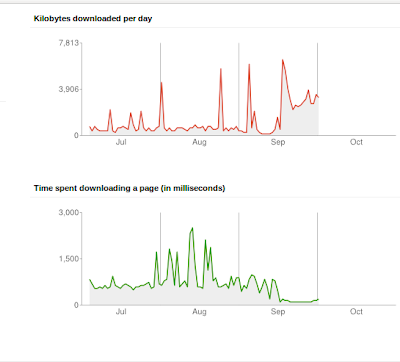
Webmaster Crawl Stats

This graph is from Google Webmaster Tools. Can you guess when the blog migration from Drupal to Octopress was done ? Yes - that's right - the middle of September (17th to be precise).

Undeniably, the performance is much better (fastest response time of 128 milliseconds) and reliable since the move to Octopress. Unfortunately, this 'before' and 'after' comparison isn't ideal. Previously, the blog was running Drupal 7, configured with a small number of modules using MySQL and hosted on cheap ($6 a month) shared hosting with Bluehost.

The performance spikes (high of 2.5 seconds to access a page !) are probably related to high usage of the Linux server my blog was co-hosted on (rather than a specific Drupal performance problem).

When I migrated to Octopress, I also moved the blog to Amazon S3 storage so it's not entirely clear how much S3 has contributed to the relatively stable and fast response times of the blog since mid-September.

With hindsight, I really wish I had phased the migration by deploying Octopress for a month on the same Bluehost hosting (using rsync) and then moved to Amazon S3. Still, it's a but late for that now.

However, it looks like I am ready for the SlashDot effect.

Diamond Geezers audience

Diamond Geezer recently posted his annual analysis of how many blogrolls he appears in. Unsurprisingly, perhaps, the number is steadily declining and he finds it harder to find new blogs to add to his list.

I thought it might be interesting to look at the blogging platforms used by the 98 blogs listed. Here are the results:

  • Blogger 60
  • WordPress.com 11
  • WordPress.org 11
  • Typepad 4
  • MovableType 3
  • Livejournal 2
  • Canalblog 1
  • Drupal 1
  • ExpressionEngine 1
  • Nucleus CMS 1
  • Serendipity 1
  • Guardian (journo) 1
  • Custom 1

The dominance of Blogger/Blogspot didn't surprise me that much. I have noticed before that it's very popular amongst UK bloggers; particularly veteran bloggers who maybe had less choice available that the plethora of options available today.

Which blogging platform do you use and why ?