Posts from April 2010

thoughts on browser usability

Jake Kuramoto from Oracle Apps Lab has a great post about common search terms for the three main search engines and notes that 'facebook.com' (and variants thereof) appear in the lists of most frequently used keywords.

Recently, I have been observing my wife who is a non-technical (Firefox) user although I must admit to a vested interest here. I am keen to understand any areas where Linux Mint is 'worse then Windows'. Over the last few weeks, I have noted the following:

The Web browser is Firefox 3.6 and the starting page is a single tab - Google.com (my choice).
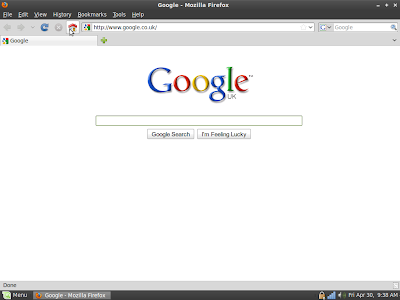
Google

This start page is minimalist in the extreme and dominates the screen. The user is instinctively drawn to this large, central area of the screen. Note to Google designers: This striking, beautiful minimalism is rather spoiled once you use the mouse.

My wife's Web session starts here. It always starts here. She might be searching for 'john lewis', 'maths revision guides', 'how to kill husband and get away with it' or 'weather london'. It is entirely logical that, if she wants to visit Facebook, she will simply hit 'Home' and initiate another 'mini-session by searching for 'facebook' (or some variant).

This may not the the quickest, optimal way of getting the job done but it's quick enough, it works and it is a learned behaviour.

I agree about search being more forgiving than typing raw text into the address bar. Google does the right thing with 'facebok' but the address bar doesn't. Don't try this experiment at work as it's potentially NSFW.

However, I think the key issue here is more about usability. The Google search page dominates the screen and the centrally placed search box dominates the Web page. Her eyes are drawn towards it. It is much harder for the brain to even consider the alternative options of 'address bar' 'search bar' or even 'Bookmarks' because these options are located at the top of the screen and are tiny in comparison - almost inconsequential. Therefore the brain has to do more work - particularly for 'Bookmarks' which nestles between 'History' and 'Tools'.

Coincidentally, I recently exposed the Bookmarks Toolbar with just two sites (Amazon, Facebook). These icons are now relatively large and easily visible and using them to quickly navigate is just a single mouse click but I don't believe she uses them. Old habits die hard perhaps.

This isn't being patronising but I don't believe she knows what the address bar is. Until recently, she didn't know what the search bar was. When I explained that the 'Google' in the bar and the magnifying class icon indicated you could search by typing into this text box, her reaction was 'Oh so it's like the Home page but smaller'. I am sure this mentality isn't unique among novice and non technical users.

She finds it confusing that the address bar takes things like 'amazon.com' (URL's) whereas the search bar takes 'amazon UK books' (search terms) and gets the two confused. Mostly this ambiguity doesn't affect the end result but it's confusing and poor UI design. Chrome addresses this nicely with a single unified bar which is exactly how it should be.

My wife often bookmarks stuff and recently complained that 'Bookmarks don't work. I can never find stuff again.' It transpired that she expected her lengthy list of Bookmarks to be listed in reverse chronological order and was unaware of the 'Recently Bookmarked' submenu. But then again, that's a extra click. Again, more work for the brain and people are lazy.

Although I am not a Web designer, I find usability and user interface design a fascinating area. I would love to conduct detailed interviews with my wife, my kids and my father to compare and contrast their usage of their respective computers.

why Susan Kramer didnt vote on Digital Economy Bill

uk

Short answer - She was in a meeting. I sent a polite email asking why my MP Susan Kramer failed to vote last night on the third reading of the Digital Economy Bill.

Dear Mrs Kramer

Many thanks for taking the time to send me a long and detailed letter is response to my email inquiry about your stance on the Digital Economy Bill.

You're right - it's a very complex issue and may yet be subject to refinements before it finally becomes law.

However, as you seemed to support the bill but oppose certain clauses, I was curious to find which way you voted last night in Parliament at the bill's third reading.

From reviewing Hansard, it appears you couldn't be bothered to vote at all. Which disgusts me.

You've just lost another vote in the forthcoming general election.

I then received this response

Thank you for all you emails regarding the Digital Economy Bill. Susan has asked me to respond on her behalf and I hope you don't mind my doing so. Please accept my apologies for the group email but we have received so many emails on this issue that it is the only way I will be able to respond to you all today.

First of all let me assure you that this is a very important issue to Susan and the rest of the Parliamentary Lib Dem party and she takes your views very seriously.

The Government has been intent on forcing through the Digital Economy Bill through the ‘wash up' as they believed it would face less opposition with many MP's having already left Parliament for their constituencies. The Government was so desperate to get this Bill through in fact that they pulled DCMS Minister Ben Bradshaw off his slot on News Night.

Bills going through the wash up are usually done in a more secretive fashion and full parliamentary party attendance is not required or expected. For this reason there were not many MPs there, but Lib Dem Shadow Minister Don Foster was debating on behalf of the Lib Dems. I have been in contact with his office over the course of the past few days passing on messages of concern from a number of constituents.

As many of you may be aware the Liberal Democrats were completely opposed to this Bill going through the wash up and wanted it to come before Parliament when it resumes after the election so that it may be subject to full scrutiny and debate. We were originally intending to table an amendment to clause 43 but decided, in light of fierce opposition to the clause, to oppose it totally. The Tories were planning to support the Government but barely any Tory MPs actually turned up.

We were unaware that there was going to be a vote on the Bill until only an hour beforehand. Susan was at that time in a very important meeting in the Constituency and despite trying, could not make it to Westminster in time. For your assurances, she would have opposed the Bill totally. Thankfully and with the help of some labour rebels and individuals, we managed to oppose the Bill. All Lib Dem MPs in Westminster at the time voted against the 3rd Reading of the Bill.

As I am sure you will now be aware Clause 43 has been totally dropped from the Bill. This is a fantastic result. Furthermore it is doubtful the rest of the Bill will make it onto the Statute books before Dissolution. Hopefully Susan will be re-elected and if so, she has promised to make the future readings of the DEB a priority and will be at future votes to represent your views.

I hope this has been of some interest to you, please do let me know your views when the DEB comes before the next Parliament and do not hesitate to contact me should you have any further concerns on this or any other issue.

Words fail me. We were unaware that there was going to be a vote on the Bill until only an hour beforehand.

Great. That really reassures me that you are on top of things.

Hopefully Susan will be re-elected.

There's more chance of Manchester United winning the Champions League that Susan Kramer securing my vote.