One of the main advantages of a statically generated blog (like Octopress) over a blogging platform that uses a database (WordPress, Drupal) is performance.
My humble blog doesn't get enough traffic for performance to be a consideration and I thought I wouldn't be able to discern any improvement.
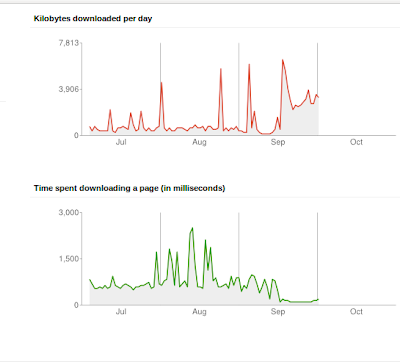
This graph is from Google Webmaster Tools. Can you guess when the blog migration from Drupal to Octopress was done ? Yes - that's right - the middle of September (17th to be precise).
Undeniably, the performance is much better (fastest response time of 128 milliseconds) and reliable since the move to Octopress. Unfortunately, this 'before' and 'after' comparison isn't ideal. Previously, the blog was running Drupal 7, configured with a small number of modules using MySQL and hosted on cheap ($6 a month) shared hosting with Bluehost.
The performance spikes (high of 2.5 seconds to access a page !) are probably related to high usage of the Linux server my blog was co-hosted on (rather than a specific Drupal performance problem).
When I migrated to Octopress, I also moved the blog to Amazon S3 storage so it's not entirely clear how much S3 has contributed to the relatively stable and fast response times of the blog since mid-September.
With hindsight, I really wish I had phased the migration by deploying Octopress for a month on the same Bluehost hosting (using rsync) and then moved to Amazon S3. Still, it's a but late for that now.
However, it looks like I am ready for the SlashDot effect.
This reduces the generation time significantly to 18 seconds.
$timerakegenerate
## Generating Site with Jekyll
unchangedsass/screen.scss
Configurationfrom/home/andy/blog/octopress/_config.yml
Buildingsite:source->public
Successfullygeneratedsite:source->public
real0m18.192s
user0m14.369s
sys0m1.368s
This is helpful for previewing the post as it will work on the site and fixing typos but still the time consuming site generation needs be to done prior to deployment.
$rakeintegrate
$rakegenerate
The second method is to use 'jekyll --limit-posts '. I added a new Rake task as follows:
desc"Generate jekyll site (last 5 posts)"
task:fastgendo
raise"### You haven't set anything up yet. First run `rake install` to set up an Octopress theme."unlessFile.directory?(source_dir)
puts"## Generating Site with Jekyll (last 5 posts)"
system"compass compile --css-dir #{source_dir}/stylesheets"
system"jekyll --limit_posts 5"
end
This also significantly reduced the site generation time
$timerakefastgen
## Generating Site with Jekyll (last 5 posts)
unchangedsass/screen.scss
Configurationfrom/home/andy/blog/octopress/_config.yml
Buildingsite:source->public
Successfullygeneratedsite:source->public
real0m59.061s
user0m40.995s
sys0m6.956s
Out of interest, I converted my content into Hyde (a static site generator written in Python).
Hyde generated the entire site in 9 mins 17 seconds. However, Hyde also supports incremental builds (which took just 34 seconds for a single new post).
I also tried raw Jekyll using the default Tom Preston-Werner theme. This took 2 minutes to generate the site in its entirety.
The last ever migration of this blog is now complete. This blog is now powered by Octopress and is a statically generated site hosted on Amazon S3.
All posts have been migrated from HTML to Markdown and every single permalink (all 954 of them) have been painstakingly checked, rationalised and consolidated.
To achieve this, I simply generated a sitemap of the Drupal site and compared this with a sitemap for a test site using Octopress after the data migration.
This unveiled a few issues that needed to be fixed:
Posts with the identical slug had a numeric suffix which was often incorrect or inconsistent after being mangled by various blogging platforms.
Some posts had the incorrect publication date (due to timezone shift) so were typically a day out.
Some posts were just missing after the 'exitwp' script was used to migrate from WordPress to Hyde a year ago.
Hyde uses a slightly different header format from Jekyll but 'sed' was able to fix this.
Jekyll uses a trailing slash for each post URL whereas Drupal doesn't.
Amazon S3 requires the canonical URL to be www.site.com with a automatic redirect to point site.com to the correct URL with the www prefix. Previously, I favoured the naked URL 'site.com'.
The permalink structure is now 'site.com/yyyy/mm/dd/hello-world/' (with a trailing slash) and will never change. Ever. Again.
I also resurrected some orphan Disqus comments by using the URL mapping tool which works brilliantly and helped identify comments associated with a non-existent URL.
I am generally delighted with Octopress as it bundles so many features I need for a blog (Disqus, Google Analytics etc) and is much easier than using raw Jekyll.
The only vague disappointment is the fact that the entire site is re-published even after a single post has been added. On my Aspire One netbook, a 'rake generate' takes 8 minutes. I might try the same process on my work laptop (faster, newer Lenovo Thinkpad) for comparison purposes.
Inevitably, there is a Jekyll fork that supports incremental deployment but the Octopress author is (understandably) reluctant to base Octopress on a fork that could quickly become stale.
Publishing the site to Amazon S3 is slightly better but, as Atom feeds get regenerated for categories, this still takes around 4 minutes.
Still, maybe this lengthy publishing process will encourage me to properly preview and get my posts perfect before publishing.
I am not sure about having all 954 posts stored in a single directory; I would rather have a sub-directory for each year but then again, being able to quickly search all posts for a keyword using 'grep' is useful.
I decided to keep the Feedburner integration for now (to avoid losing my two readers).
The use of a statically generated site also killed one of my favourite features - my legendary and award winning rotating tagline. Oh well.
Blogging like a hacker but publishing like a snail with a heavy weight strapped to his back.
Loose thoughts on the plan of attack for the blog migration:
Install Octopress locally
Configure S3 and install a dummy Web site.
Use's3cmd' to upload test site to Amazon S3
Test incremental uploads. This is a firm requirement.
Full database backup of existing Drupal blog
Take backup of Drupal installation (additional modules, scripts).
Install vanilla Drupal 7 locally.
Install copy of the existing Dupal blog in local version (overwrite database ?).
Use the Drupal to Octopress migration script. This extracts nodes from the database and creates Markdown files for each post, This script is probably for Drupal 6 so some tweaks (major rewrite) may be needed for bleeding edge Drupal 7. URL aliasing is supposedly supported.
Test the various elements in the checklist. Disqus comments need the correct domain name so will have to come last.
Configure a redirect from 'nbrightside.com' to the Amazon URL. I can see trouble and lots of Googl'ing here.
Place source code (Markdown posts) into GitHub repository.
My Web hosting package (provided by Bluehost) expires in October. As this blog is essentially dead (the last post was a one-liner 8 months ago), the sensible and logical thing to do would be to kill the blog and save £5 a month.
Originally I purchased the domain name 'nbrightside.com' and the Web hosting for a couple of reasons:
I wanted to use self hosted WordPress without some of the restrictions imposed by WordPress.com
I wanted to play with some of the packaged applications offered by Bluehost.
I wanted access to a Linux environment, mainly to build, install, experiment with various open source software tools and packages which needed a LAMP stack.
It's really questionable whether I need to maintain this Web presence but, on balance, I'd like to keep the site alive for a little longer.
WordPress, Drupal, Habari et al are all fantastic blogging platforms but rather overkill for this simple, single user blog. For a while, I have been fascinated and trying to resist the temptation of the simplicity and power of static Web site generators like Jekyll and Hyde.
Last year, I even ported the complete contents of this Drupal 7 blog to a locally installed version of Hyde and laboriously fixed up lots of hyperlinks just so the Markdown looked neater.
The completely logical and sensible decision would be to simply resurrect this Hyde environment, re-sync the last couple of one liner blog posts, configure a automatic redirect and use rsync to upload this site to some alternative, cheaper (or free) Web hosting.
So, I have decided to use Octopress and Amazon S3 to host this humble, annually updated blog in the future. I may be able to reuse some of the Hyde content with judicious use of sed to convert the meta data in the header sections or I may just start afresh.