Recent Posts

Comet 0 Customer 3

At the weekend, I purchased a new printer after replacing the ink cartridges failed to reinstate the ability to print in black on my Canon IP4000.

Previously, I'd researched which printers had decent Linux support and decided on an HP Deskjet 3050. This is a wireless printer so I hoped that the Windows PC's in the house would be able to print directly and the management of the printer (inkjet levels) would be easier. My current Canon IP4000 has served me well but is pretty old and I was surprised to find I could pick up an HP wireless printer for £34.

I checked the price on Amazon to find the price has risen to £38.99 in the intervening two weeks - not just at Amazon but at all online retailers I normally use. No problem - still excellent value. As Norma is patiently waiting to submit a couple of essays for her course, I decided to venture out to try to buy a printer as delivery times from Amazon could be delayed given the recent cold spell.

I walked into Comet - the HP Deskjet 3050 was on the shelf listed at the price I'd originally seen - £34.00. I darted next door to a cavernous PC World which is the size of a aircraft hanger and a gadget heaven. They also had the printer but now at the higher price of £38.99.

I went back to Comet, picked up the last remaining Deskjet box and walked up to the till. The girl swiped the barcode and said (much as I expected) - 'That will be £38.99, Sir'. 'Oh I think that's a mistake - it's listed as £34.00 on the display'. 'No, sorry, Sir. It's coming up on the computer as £38.99'. 'Sorry but the price on the display is £34.00 and you have to charge me that price for the printer. It’s the law'.

She interrupted me ‘Well I will have to see this for myself. Can you show me ?' So we both ambled over to the display area of various printers. The shop assistant wasn't best pleased and she muttered ‘Are you absolutely sure it's the same printer, the same make and model ?'

We arrived at the display item for the HP DeskJet 3050 printer where the price was displayed as clear as day, in black and white as £34.00. She turned back towards the till without a word so I duly followed, feeling slightly guilty.

'Right then, Sir'. And she entered a manual override for the price and entered £34.99. That will be ‘£34.99 please'. ‘But the price is £34 dead, £34 exactly'. 'Was it ?' By now my patience and my good humour at finding the desired printer in stock and saving £5 was being tempered by this girl's surly and unhelpful attitude.

‘Listen. We've just walked over to check the price. We did that because I know what the price is but you don't. Didn't you even look at the price ? What was the point of going over if you're can't be bothered looking at the price?'

‘So you're really going to argue with me over 99p are you ? I've already keyed it now.'

'Yes - because the price is £34.' She emitted a long sigh under her breath and she entered the correct price and I proferred my credit card.

And now in a voice scarily reminiscent of Catherine Tate as the TGI waitress; ‘Would you be wanting extended insurance cover with that, at all, Sir ?'. 'Oh no - thanks - just the printer, thanks.' 'Insurance cover is available for just £24.99 for 3 years and £34.99 for a full, comprehensive 5 years peace of mind'.

'I’m not really likely to insure something that cost me £34 for £35. If it blows up after 1 year and 1 day, I’d just buy another printer that is likely to be better, faster and probably cheaper.'

‘Well that's entirely up to you, Sir but these printers can be quite unreliable.'

'No really. Just the printer thanks'. 'Right - so that’ll be £34.00 for the printer then.'

I went to nudge the printer box towards me in a precursor to leaving this godforsaken store and erasing this girl's morose, stupid, miserable face from my memory bank. For ever.

‘Can I interest you in more ink cartridges, Sir ? Special offer in December on all inkjets - buy one set of ink and get another one at half price.'

‘No thanks. I normally get my cartridges off the Internet.'

‘OK, Sir. That's entirely up to you but I must tell you that printers only come with a 'starter pack' which only print 50 pages or so so you might run out very quickly.'

I smelled bullshit here but I wouldn't put it past the printer companies in an effort to recoup their loss on the actual device to ship with smaller, low capacity cartridges. Worse, the spectre of Norma printing out several lengthy papers and articles and the ink running out just as she printed of the final revision of her essay for submission was hovering overhead like a hungry vulture.

'No thanks. No insurance. No additional ink. Just the printer. Thanks.'

I got home, quickly installed and configured the printer and discovered HP provide two standard cartridges (black and the 3 colour mix). No starter pack.

I quickly checked wireless printing from three Windows computers (XP, Vista and Windows 7) and downloaded the latest version HP native Linux software (HPLIP) to configure and manage the printer which was conveniently available in the Fedora 14 repositories.

Finally, I ordered two spare cartridges from Amazon for £20 compared to £24 at Comet.

train the trainer

In my job as a roving IT consultant, I have given a number of technical presentations about Siebel. During that time, I have learned that I am much more comfortable presenting material and content that I have created myself. I have also presented slide-decks used by technical pre-sales. This has occasionally led to detailed questions arising about a very innocuous looking bullet point which I was unable to effectively answer; not a comfortable situation.

Occasionally, I have delivered technical workshops about a very specific area of the Siebel product set that was tailored to a customer requirement for a module that is not covered by a formal course offered by Oracle Education. I have thoroughly enjoyed this type of work as I find it stimulating and very rewarding. I also felt the customer also found these workshops useful and valuable.

Last week, I gave a 2 day workshop about EIM (Oracle's ETL tool to bulk load data into a Siebel OLTP database) and I actually created some practical lab exercises to give the attendees some hands-on experience of failing to load data using EIM. I'm being serious here - I firmly believe it is very important to be exposed to the different classes of errors and idiotic mistakes when trying to achieve a seemingly straightforward task of populating a single customer record.

I visited the client's offices the day before to check the logistics and the Siebel environment provided for the workshop. I also took the sensible precaution of completing the various exercises myself. To my horror, I discovered at 3pm on the day prior to the workshop that EIM wasn't actually functional in the customer test environment. Thankfully, I discovered this was due to a missing Service Pack for the Microsoft SQL Server database which resolved the problem and saved me from a very embarrassing situation.

Whenever I've attended training courses, I've always felt slightly uncomfortable whenever the instructor went walkabout and hovered over my shoulder as I struggled with the syntax of ‘ALTER TABLE'. Consequently, when I set the attendees loose on the first exercise, I tried to take a back seat and only help if someone requested assistance.

I am not a teacher - in fact, I am a lousy teacher as I have precious little patience - and I am not a trained instructor. However, I was quite curious to see how different people attacked the problem. One chap was feverishly reading the manuals, typing at speed, running the tests, examining log files, iterating in an effort to win the race. One of his colleagues had a rather more considered approach and I noticed he chose to take time to assist his neighbour who wasn't as far forward. Another attendee was very methodical and thorough; he essentially created a full source-target mapping in Excel before he did anything else and was completely unfazed by the progress of others around him. Another gentleman reminded me of myself - he was bludgeoning forward at breakneck speed, making mistakes (syntax errors), immediately fixing them and iterating rapidly.

I approached one gentleman quietly beavering away in the corner who had actually completed the original exercise but hadn't shouted ‘Eureka' or called me over to praise his efforts. Instead, he was now creating a data set of 10,000 customer records to see what throughput he could get compared with the performance of the existing custom COM based data loading tool.

All in all, a very enlightening exercise. Psychologists would probably classify each type of individual with a special name (‘Starter-Finisher').

an evening with James Cracknell

Back in May, I went along to my son's school to hear James Cracknell speak. Cracknell is an old boy of KGS and went on to become a double Olympic gold medalist. Since his retirement from rowing, Cracknell has embarked on a series of endurance challenges. Cracknell supplements his income by writing for the Daily Telegraph and also gives after dinner speeches about his adventures as well as motivational talks at corporate events.

On a balmy May evening, I entered the school building and was pleasantly surprised to see free champagne being dispensed to guests on arrival. I stepped forward to the temporary bar to claim my complimentary glass of bubbly. ‘Are you a Governor, Sir ?' ‘Err, no.' ‘Well - are you with the VIP party, Sir ?' - the gentleman gestured to my right where I saw the Headmistress chatting with Cracknell. ‘Err, well, err, no.' And with that, the smartly dressed waiter, nodded disdainfully towards the Sixth Form Common room where I was able to claim my free class of orange squash in a plastic tumbler.

If Norman Junior III had been with me, this exchange would have been excruciatingly embarrassing for him but sadly he couldn't be bothered coming along.

Before the main event, I paid a quick visit to the toilet and I noticed James Cracknell, still politely chatting with the VIP's, wearing an immaculate charcoal grey suit, with a spotless white collared shirt and no tie. To my horror, my eyes were drawn to his feet. He was wearing trainers. One of my pet hates - idiotic commuters wearing suits and trainers. Oh well, he's won two Olympic Gold medals so I guess he can wear whatever he likes.

Cracknell was a very personable, engaging, natural speaker and treated us to a quick run through his career including his Olympic triumphs, an insight into the level of commitment required to succeed at the highest level of competitive sport and his trip to the South Pole. Sensibly, Cracknell supplemented his talk with lots of photos. Interestingly, he seemed to focus on his occasional failure (fourth in the rowing World Championships in 2003) as much as his many successes.

James Cracknell is a very articulate, modest and amusing man. He described failure at the World Championships as ‘doing what we normally do. Train like hell for two years, getting up at 5am to get onto the water on those dark, freezing winter mornings, qualify, get to the final, push yourself to the limit, cross the finish line then stand on a podium standing next to your best mate [Matthew Pinsent] who is crying like a baby. Again'.

When Cracknell was selected to join the coxless four for the 2000 Olympic Games in Sydney, he was the newcomer into an established boat with Olympic Gold Medalists, Steve Redgrave (4 Gold Medals) and Matthew Pinsent (3 Gold medals) Understandably, he was a little intimidated by these two and German coach, Juergen Grobler, attempted to reassure him

‘Listen, James. You are strong. You are an excellent athlete with great stamina and rowing technique. However, in this boat, you are sitting behind Matthew. He is a better rower than you, stronger than you with more stamina. All you have to do is follow him.

Just do what he does. Follow his stroke. Follow his every move. When he eases off, you ease off. When he pushes the rate up to 43, you push the rate up to 43. Matthew is hung like a horse.'

A few months later, Cracknell was recounting this story about Juergen's motivational chat to Redgrave who smiled and said “I think Juergen probably said ‘He has lungs like a horse'.”

Cracknell then described his first endurance event when he rowed across the Atlantic with Ben Fogle. Towards the end of the race, the satellite radio wasn't working properly so the pair could only get daily updates on their position and the state of the race.

One call told them they were now positioned second with 36 hours to go. Fogel's reaction was ‘Second - brilliant. What an achievement. Fantastic !' whereas Cracknell's immediate reaction was ‘Right - let's stop these 3 hours on (rowing), 45 minutes off (rest) shifts and switch to 4 hours one, 30 minutes off and see if we can win this bloody thing'.

Cracknell then solved the mystery of the immaculate grey suit and trainers. He had recently returned from the Marathon Des Sables endurance event where he had finished 12th in a race, the highest ever placing for a Briton. During the 151 mile race across the Sahara desert -, his feet were badly blistered - Cracknell showed an awful photograph of his red raw feet after a day in the desert which he described as ‘slight chafing' - which explained the trainers and his slight limp as he took to the stage.

Cracknell answered a question about how he motivated himself and he referred to a note scribbled on a blackboard in a History classroom he had seen earlier that evening on a tour of his old school. Some wag had written 'All things must pass' which summed up his attitude pretty well.

[After I saw Cracknell, I was shocked to hear he had been knocked off his cycle by a speeding truck when attempting another challenge to cross the States in 18 days, rowing, cycling and running. Cracknell was seriously ill with head injuries but thankfully is now making a good recovery.]

all change please

This blog is now running on Drupal 7 (beta 3).

Currently Disqus comments are absent but I am hoping the Global Redirect module and the Disqus crawler will remedy this given time.

Most of the modules I require are available for Drupal 7 apart from FeedBurner so I have just re-pointed the feed for now.

Let's see if this appears on the other side.

I will probably convert to using MarkDown markup in due course too.

Main reason for ditching Habari was the lack of user forums.

why I hate Kitties and Whips

I was recently in a pub when a lady looked expectantly at me and said ‘Fancy a whip for this ?' I looked a little taken aback and hesitated until she helpfully clarified ‘A kitty. For the drinks. Shall we have a whip round and Ill then buy some drinks. In a very polite British way, I proffered a ten pound note and said ‘Oh that will be great. Thanks for sorting that out. A pint of London Pride for me, please'.

Whereas what I really wanted to say was. ‘We are two couples having a quick Saturday night drink after watching some amateur dramatics featuring some friends. It's five past ten so we'll probably have two drinks. Why on earth should we contribute to a kitty ? You buy us a drink and I promise that we will reciprocate.'

There are many different problems with these whiprounds and kitties:

  • Someone has to manage the money.
  • Someone, normally the fastest drinker, always ends up thirsty as, like a training course, the pace is governed by the speed of the slowest person present. If girls are involved, you can actually die of thirst and lose your kitty contribution.
  • People always think things are cheaper than they actually are so are sceptical when the demand comes round to top up the kitty.
  • As the night progresses, people become less inhibited and contribute massive amounts ‘Here's £50. That should sort it for a while.'
  • At the end, the kitty has to be sub-divided and the proceeds returned to all contributors. This is a variant on the ‘splitting the bill' syndrome at a restaurant - only more complicated and time consuming. Forget the last train home. You've missed it. You're getting an expensive taxi. Still, at least the drinks were equitably divided.
  • I once had the misfortune to be appointed ‘Kitty Treasurer'. This was a complete nightmare because people expect you to continually go to the bar. Time after time because ‘you've got the whip'. I never spoke to anyone but the bar staff all night.

So please don't invite me into your ‘kitty' or contribute to your stupid ‘whip'. This is the correct and proper way to ensure a night of trouble free, enjoyable drinking:

  • Get in a round with mates who drink at vaguely your rate. With blokes this doesn't matter as slowcoaches simply accrue 5 full, untouched pints while the rounds continue to be brought over to the table regardless.
  • Ensure the rounds are ‘equalised' by the end of the night. This means that everyone in the round buys the same number of pints. I can't emphasis the importance of this enough.
  • Choose the size of the round appropriately. If you're in a group of 4, you need to prepare to sup 4, 8, 12 or even 16 pints.
  • Large groups can lead to livers the size and colour of George Best's. Consider splitting large groups into 3's or 4's.
  • Don't skew the financial calculations by having a crafty ‘Southern Comfort' on the penultimate round because ‘I'm a little full of beer'. Just drink pints. You're a man. That's why you're in a pub not a wine bar.

a year with Linux

Last week saw the first anniversary of my adoption of Linux on my desktop PC so I thought I'd write a quick summary of how things went in the last 12 months as I always enjoy reading real-life user adoption stories.

Initially, I installed Linux Mint 7 (Gloria) on my aged Dell Dimension and in the following weeks, I subsequently upgraded to Linux Mint 8 (Helena) in November and again in May 2011 when Linux Mint 9 (Isadora) was released.

In April, I finally heeded some not so subtle hints from my wife and bought her an relatively inexpensive Acer Aspire laptop for her birthday. The machine came pre-installed with Windows 7 but, as she had been gradually getting used to the Linux Mint interface and had never previously used Vista or Windows 7, I took the rather bold step of unpacking the laptop and surreptitiously installing Linux Mint. This was mainly because I felt constantly switching between Linux and Windows may prove to be rather confusing and hinder the drive for Linux adoption.

The laptop proved to be a great success and my wife initially used AbiWord to write essays for a part-time course she was studying. We had the inevitable hiccup when she emailed AbiWord format documents to colleagues at work who were unable to read them. Although I managed to get AbiWord to use the Microsoft Word .doc format by default, I still saw the odd compatibility issue which led me to install Open Office Writer.

In June, my wife had to give a short 5 minute presentation for an interview and created the slides in Open Office Impress and then presented her work, from a USB stick, on a Windows computer using Microsoft PowerPoint. Although I had tested this route (48 times) myself, this successful use of Linux software went down very well and seemed to boost her confidence that using this ‘Linux thing' wasn't so bad after all.

My wife mainly uses the two computers for Internet access, email, simple word processing and printing. It was quite interesting to see that she fully expected everything (email, files, Firefox favourites) to be identical and immediately available on both machines. Obviously, this isn't the case out of the box but luckily, my ISP, Virgin Media, had recently converted to the Gmail platform with IMAP available so I configured Thunderbird on both PC's and, lo and behold, all her email is simultaneously available on both machines as well as being backed up on a server elsewhere.

For file synchronisation, I toyed with configuring simple network file sharing between the two Linux boxes but as the desktop PC isn't always turned on, this wasn't too attractive. I also installed DropBox which I thought would be ideal but, by then, the wife had already become accustomed to sending documents to herself via email which did the job just as well.

For browser synchronisation, there was a useful Firefox addon called Xmarks that worked seamlessly. Unfortunately, the Xmarks service will be closing down at the end of the year so I have converted to Firefox Sync that seems to offer similar functionality if not quite as polished.

As the year progressed, my wife increasingly used the laptop almost exclusively and really only used the desktop PC for printing documents. This was a blessing really as it allowed me to embark on a period of concerted distro hopping to see what other Linux distributions were available. After experimenting with Debian, Linux Mint Debian, Fedora, Ubuntu, PepperMint and Arch, I eventually settled on Fedora 13 (Gnome) which is very stable and comes with all the main software packages I use. Being based on RedHat, Fedora offers a nice contrast with Linux Mint which is based on Ubuntu which, in turn, is based on Debian.

As for the future, well, my wife keeps asking for a quick Nautilus tutorial on how to effectively manage and organise her growing number of files as currently, her documents and downloaded papers from the Internet are liberally scattered across ‘Downloads', ‘Home Folder' and ‘Documents' and the temporary folder used by Firefox.

My wife seems quite content with Linux; in fact she recently recounted colleagues telling war stories over lunch about their computers being out of action after being struck down by viruses and having to purchase a Microsoft Office license just to be ‘able to work on documents at home.' My wife told them that her husband had installed this Linux thing onto her computer so she didn't have to worry about viruses and she used a ‘free' version of Word.

From my point of view, the laptop is fast and still boots as quickly as the day I installed it. No Windows or vendor crapware, no spyware and no crippled, limited period anti-virus program suites to be uninstalled which would have undoubtedly been the case had I left Windows 7 on the laptop.

There are a couple of minor irritations; printing on Linux is OK but it is still difficult to accurately monitor the ink levels on the Canon Pixma ip4000 without hooking up a Windows laptop and my wife is able to occasionally crash Open Office Writer simply by copying and pasting content from Web pages into a document which is rather embarrassing.

The laptop runs Linux Mint 9 (LTS = Long Term Support) which means this version will continue to be supported for a full 3 years until May 2013. However, there is also the tantalising prospect of migrating to Linux Mint Debian which looks and feels like Mint but decouples the dependency from Ubuntu and is based directly on a rolling Debian release which is quite attractive as, theoretically, this would never need upgrading (as in a re-install).

Also, today, hot on the heels of last week's Ubuntu 10.10 release, the Mint development team has just announced the first Release Candidate for Linux Mint 10 (Julia) today which is another possibility.

As for the desktop PC currently running Fedora 13, I quite like Fedora as it's stable, fast, looks great and offers a comprehensive list of up-to-date software available in the repositories. Fedora also appears to be gaining in popularity so I may well upgrade the desktop PC to the imminent release of Fedora 14.

Rooney heads for the exit

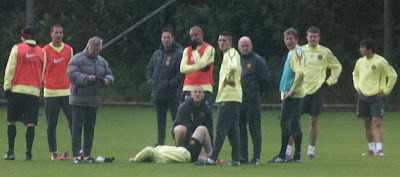
I admire Wayne Rooney's skills as a footballer and I honestly don't give a flying fig about his sordid, personal life. Unfortunately, I don't think Wayne Rooney is blessed with that much intelligence. This isn't a criticism, merely a statement of fact.

If Alex Ferguson says the sky is green, then the sky is green. If Alex Ferguson says you have an ankle injury, then you have an ankle injury.

Sadly, for Rooney and Manchester United, I sense the writing might now be indelibly marked on the wall for his career at Manchester United.

Rooney should just ask Beckham, Keane, Stam and van Nistelrooy.

starting from zero

One of my favourite and regular UK bloggers, Jonathan Beckett, had gone rather quiet recently so I assumed he must have moved blogging platform the the Nth time, gone on holiday or possibly his feed was screwed without his knowledge so I sent him a polite email asking ‘Dead or just resting ?' and he informed me he'd intentionally changed blog address without telling anyone.

I think this sudden, unannounced, abrupt loss of service is an excellent idea for all bloggers - it's a bit like writing ‘I love small, fresh, juicy satsumas' buried deep in the middle of a technical report to be delivered to a client or pausing for 5 minutes, with your face in your hands, during a presentation at Oracle Open World. It helps to focus the mind and check whether anyone is actually reading or listening.

In fact, this method of social network suicide followed by starting again from zero and organic gardening is a strategy I have used more than once during my blogging lifetime. The only difference is my stats genuinely reverted to zero but I wasn't inundated with curious Tweets, scribbling on my Facebook wall, IM's and concerned email messages enquiring about my state of mind and asking for details of the new blog feed.

I was greeted a wall of silence, pierced only by a solitary email: ‘I simply adore Clementines'.