I have most of my music available in digital format and have
occasionally pondered the purchase of a wireless streaming
device so I could
listen to music anywhere in the house.
Another possibility would be to upload all the music to my own server
and stream music from any computer using freely available software (e.g.
Icecast).
Of course, both those options cost money and more importantly, time so,
as always, I chose to so absolutely nothing apart from duplicating my
iTunes library on my two main (home/work) computers.
Well that's not entirely true - over the years I have had an on-off
friendship with last.fm. Last.fm is
a social network which allows you to log music you are listening to,
mark favourite tracks, create and share playlists with friends so you
can use it as a discovery engine. This didn't entirely work for me - I
simply marvelled at people's shocking taste in music and wondered how on
earth 'Plastic Bertrand' even appears on the Habari group.
Recently, I picked up on a new music service called
Spotify and scoured the Web to secure an
invite. I was immediately impressed with Spotify - you have to download
a desktop client but after that, you are free to play music - streamed
from their servers. In fact, I think there may be an element of peer to
peer and BitTorrent going on behind the scenes as Spotity does use disk
space on the local PC as a cache.
Anyway, streaming music was hugely impressive - playback was completely
seamless - no stutters, no pauses, no jumps. It was just like playing
music locally in Media Player or iTunes. Spotify doesn't have all the
world's music collection available on their servers but fortunately I am
stuck in an 80's musical timewarp and the vast majority of my narrow
tastes are catered for on Spotify.
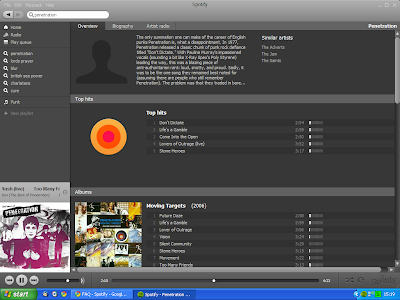
I also really like Spotify's interface - simple, intuitive and
reassuringly grey. Guess what - you can choose your favourite artist and
then select an album (unlike last.fm that insists on playing your
library in an arbitrary order which is incredibly annoying when you want
to listen to a specific album or track).
So how much is Spotify charging for this wonderful service ? Well, it's
free although there are occasional audio adverts sprinkled in between
songs although in my view, the adverts are not invasive (every 5 or 6
songs) and no worse than commercial radio - a lot better in fact. There
are also visual ads in the Spotify aplication, but again, I don't find
these too bothersome. If you do, there are subscription options for an
ad-free service although at £10 per month, I think this option is way
overpriced.
What's the catch ? Is this illegal ? Isn't this Limewire dressed up with
a different interface ? Well - no because Spotify pays the artists and
labels for access to the music so the content on Spotify is legal. In
fact, Spotify does contain some content from dubious sources which is
occasionally being trimmed and removed from the servers as it is
identified.
The good news doesn't end there. The labels, bands and A&R men behind
Led Zeppelin, Pink Floyd, AC/DC, Metallica and The Beatles refused to
share their music so there is simply no way you can ever encounter any
of that dross. Ever.
The only two main omissions that I care about are The Smiths (hears loud
cheering in the distance) and that Beatles tribute band fronted by two
brothers from Manchester - Oasis (hears more loud cheering).
Using Spotify I can access most of my music library from any PC (desktop
or work laptop) and there's an option to automatically update last.fm
with tracks played.
Does this signal the death of the music industry and mark my last ever
CD purchase ? Well - no, ironically Spotify has sparked my interest and
unveiled more hidden musical nuggets ('Entertainment' by 'Gang of Four'
to name just one) I had completely forgotten about. Consequently, I will
probably go out and buy now more CD's as I also listen to music on my
iTouch and in the car.
Anyway, Spotify is only available in selected countries at the moment
and subscription is by invite only (Google Blog Search is your
friend)
but today Spotify opened up to users in the UK without the need for an
invite.