Posts in category "Google"

Google Music - available by 2017

A few weeks ago, I signed up for a invitation to Google Music. The service is only available in the US but, by a lucky chance of fate, I just happened to be connected to my corporate VPN so I was successful and an invitation duly arrived in my Inbox.

Initially, the Google Music Manager software didn't support Linux. Nor was the Ogg Vorbis audio format supported so I didn't pursue it any further as both of these were show stoppers for me. I don't intend re-ripping my entire music collection to MP3 format.

However, last week, Google released a Linux version of Music Manager and added 'support' for Ogg format audio files. The 'support' for the Ogg format is slightly strange - Ogg audio files will be transcoded back to 320kps MP3 files which represents a conversion from one lossy format to another lossy format. Hopefully, in the longer term, there will be true native support for Ogg.

Anyway, I downloaded the Music Manager software and started uploading my music collection mainly so I could listen to music on my netbook which currently runs Chromium OS.

I started the upload 2 days ago and it's been running during the day. So far, it has managed to upload 505 songs out of a total 1,880 so it's not exactly a speedy process.

where's your Google Shared Items ?

I have followed the development of Google Reader since it was launched in 2005.

Having used Thunderbird and then NetVibes, I have used Google Reader for the last two years to read blogs. The main reason I like Reader are the UI, the keyboard shortcuts for quick navigation and the fact I can also use it on mobile devices and multiple computers.

During that period, I have sporadically marked articles that interest, amuse or shock me on my 'Shared Items' feed and Google recently added improved support for the sharing of 'Shared Items'.

I normally try to use 'Share With Note' and annotate the entry as to why I found it noteworthy and I also mark items with a 'Star' as a private bookmark; normally as 'To read later' or 'Possible input for blog'.

Google have recently improved the sharing of 'Shared Items'. Happily for Google, the timing of these new these features just happened to coincide with FriendFeed's acquisition by FaceBook which prompted much fear, uncertainty and doubt amongst the FriendFeed community, some of whom are looking for viable alternatives if FriendFeed development comes to a halt (or worse, the service closes).

Louis Gray and Rob Diana have both adopted Google Reader which has helped to spark interest in the service and Google is already making additional tweaks and improvements in response to user feedback.

Personally, I have started to develop (yet another) network of people sharing content of interest and already I can see a change in the way I consume content in Google Reader. Firstly, I scan the 'Shared Items' of my group and I tend to find that, by the time, I get to my conventional list of feeds, most of the articles of interest have already been brought to my attention earlier by the 'Shared Items'.

However, there is a problem with de-duplicated posts and even with 50 'Friends' managing the signal to noise ratio promises to be an issue. The social features are relatively new and there are a few rough edges in Google Reader (people keep getting dropped from 'Groups, people can't comment on an article without being a member of a group) but for me, Google Reader has the potential to supplant FriendFeed as it focuses on the content (news, blogs etc) that interests me (rather than LOLcat pictures).

I also believe annotated shared items are much more valuable and than a plain, old, tired, outdated blogroll.

Here's my feed of 'Shared Items'. If you use Google Reader, it would great if you could share your 'Shared Items' feed in the comments below as I would be genuinely interested in seeing what you're currently reading and enjoying.

the resurrection of Google Reader

Google have recently added some social features to Google Reader which enables much improved sharing of peoples Shared Items.

The features have re-energised my use of Reader as these were features I have wanted for a long time.

Gmail on the up down under

Although it's very cool to post on the corporate message board: Hey - why don't we save the company millions of dollars by using Linux, Gmail and OpenOffice ?, there are obvious barriers (security and Excel Luddites to name but two) to large corporations adopting server based software.

However, I always thought Google Mail would be an obvious fit for academic institutions to reduce the costs of software licenses and IT management. Adoption of such 'software as a service' would make sense as although some students are 'late risers', the majority could also be classified as 'early adopters' who are comfortable with the technology.

This recent announcement that the Department of Education in New South Wales will roll out (a customised version of ) Google Mail to 1.5 million students is an interesting development.

The cost of the new system will be $9.5 million as opposed to the $33 million for the previous Exchange/Outlook based solution with students getting an increased quota of 6GB (previously a miserly 35MB).

Although the initial contract is purely for email services for students only (no Google Talk), the obvious extension is to include Google Docs and Spreadsheets to displace Microsoft Office.

SEO wars Google versus Yahoo!

When I moved this blog from hosted Wordpress , I submitted the site to Google and Yahoo! After that, I noted the respective crawlers indexing the blog and thought no more of it.

I subsequently registered the site in Google Webmaster and Yahoo! Site Explorer and added a sitemap to help the robots index my site more efficiently. After a while, it was clear that Google was responsible for the vast majority of traffic to my humble blog. Mainly 'one-hit wonders' but welcome nevertheless.

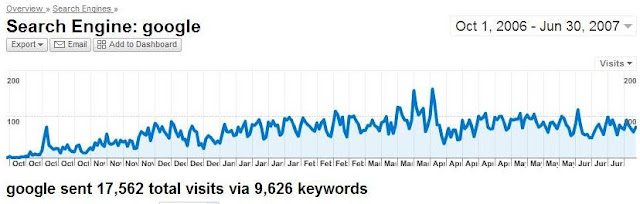
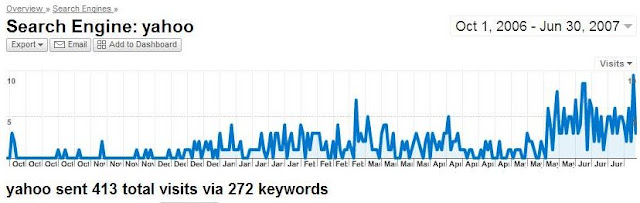
Today, while dabbling with various reports in Google Analytics, I compared the performance of the two major search engines over the past nine months.

Google

Yahoo

The statistics are quite staggering, to me at least. So much so, I have been moved to include inline images (which took me 14 hours and they're still not right) to reinforce the point.

Over a period of nine months, Google (17,562) absolutely hammers Yahoo! (413) into the ground.

So then I started to get curious. Why does Google do such a better job of indexing my blog ?

The standard test I use is to search for a set of keywords from a recent blog entry and see whether it appears on page 1.

For this test, I used "under the covers at Wimbledon' from a post made last Sunday. On Google, this appeared as the first post in the first page. I already know that Google is very timely at indexing my blog. If I post an blog article with an internal link (pingback), my RSS feed of Google inbound links notifies me instantly.

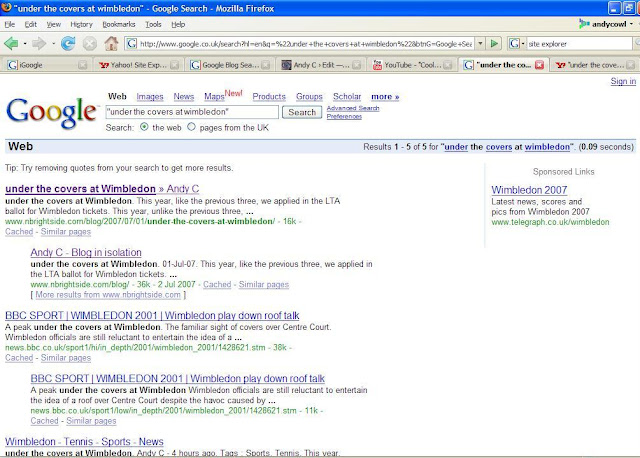
Here are the Google results. The blog article is the first entry displayed on the front page.

Google Search

OK. So now for Yahoo!

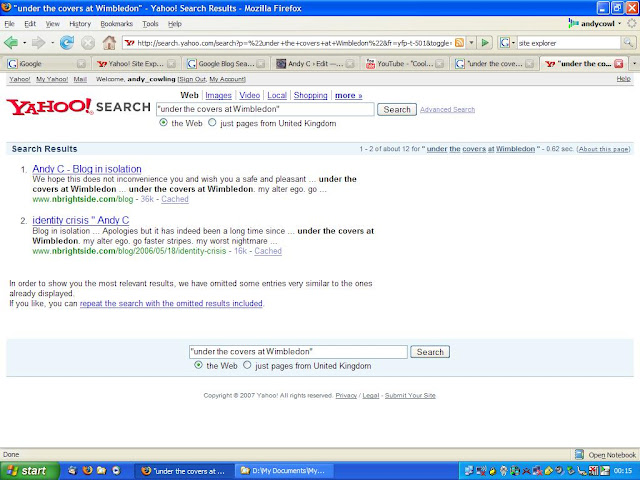
Here is the Yahoo! equivalent. Nothing for the actual blog article on page 1. However, the main blog page is listed which happens to contain a snapshot reference to the article title.

Yahoo Search

Which is more relevant ? Which looks a better match for the actual search terms ? Which one would you be tempted to click on ? Which site would you advertise on ?

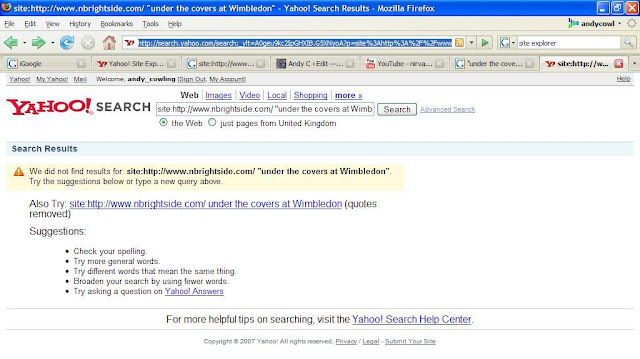
Next, I went to Yahoo! Site Explorer to see whether the actual blog article was indexed yet.

Yahoo Missing

No it wasn't. So, an interesting experiment and I am sure SEO magicians in white hats will arrive promptly to point out the error of my ways.

A footnote : The Yahoo! chart does appear to shows worrying signs of life from mid-May. The number of daily referrals jump from almost zero to almost a whole 10 visitors in a single day !

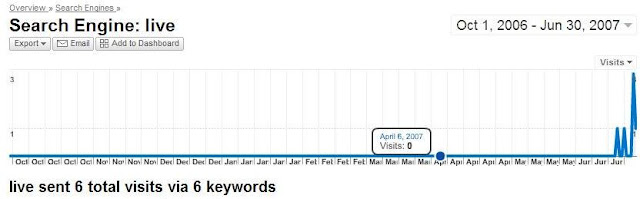
Come to think of it, Live.com (previously known as Dead.com) has also recently sparked into life, rising from the floor to reach the dizzy heights of a spike of 3 daily visitors.

Live Search

Google beware !

Google finally sees sense

On the face of it, the recent changes to the interface to Google Docs and Spreadsheets look trivial and superficial.

Googles official announcement is brief and understated but Google Blogoscoped hits the nail on the head (twice):

'The file listing now resembles a more traditional view in the style of, say, Windows Explorer.'

...that ordinary mortals understand and are comfortable with.

'Google D&S looks more and more like an office application.'

In fact, Google Docs looks and performs much better than the most popular office application. I recently upgraded three home PC's to Office 2007. I think Microsoft Office is a superb suite of professional applications (Word, Excel, OneNote) and represents great value for money as £85 buys licenses for use on three separate PC's.

Inevitably though, my wife hated the new Word interface (shock of the new) because 'everything had changed' and she could not easily locate the old 'Print' button or even 'File-Print'.

My wife doesn't use Google Docs and now she has mastered Word 2007, she probably never will.

However, if she ever does, it will be easy to teach her how to migrate. If she wants to print a document, she clicks the 'Print' button or the pretty picture of a printer. This is completely intuitive and obvious. She won't have to call the Helpdesk and interrupt the Champions League Final just to print two copies of her CV.

If my wife wants to delete a document, she either selects the document and clicks 'Delete'. Alternatively, if she has successfully completed my 3 days 'Advanced Course' (a bargain at £150) and is officially certified, she simply drags the document to the dustbin. Two choices. Both quick, easy and obvious.

Another occasional task my wife needs help with is finding her CV. She keeps all 178 documents in 'My Documents'. She doesn't archive files by year. She doesn't remember that she last updated the CV in May 2003 nor does she know whether the document is named 'CV', 'Curriculum Vitae' or 'CV-Full' or 'CV-May-2003' .

She can't fathom out the search interface from within Word (nor can I) and does not know that you can search for Word documents from a completely different application - Windows Explorer. She simply wants to find her CV. From within Word. Quickly.

In Google Docs, she types 'CV' in the 'Search' box and is offered all the available possibilities with intelligent auto-complete.

This isn't patroqnising. This is all about usability, interface design and mass market appeal.

If Auntie Beryl writes yet another letter to her bank, she simply drags it to the 'Letters' folder. She doesn't need to know that this isn't really a folder and the document is now tagged as 'Letter'.

Uncle Harry doesn't need to know the definition and intricacies of folksonomies. He doesn't care that, strictly speaking, this document could also be multiply tagged 'Bank' and 'Personal'. He just wants to type the letter, run a spell checker, quickly print the thing and make the 5 o'clock collection.

I honestly believe, in the future, this seemingly trivial change will be viewed as the turning point when Google changed from a marginal, Web 2.0 application and started to offer a credible alternative to Microsoft Office (for personal but not corporate users - yet). This was the day that non Web 2.0 users can now be introduced to Docs and actually understand and use it.

Ironically, the revamped Google Docs interface is very reminiscent of the Web based interface of Office 2007 which is another excellent software product and unbelievably close to the desktop equivalent.
resisting the lure of Google Reader

I am a big fan of Netvibes but also follow the ongoing development of Google Reader with interest. Increasingly, I find myself tempted to convert to Reader permanently.

  • Speed - Google Reader has a set of keyboard shortcuts that make scanning a large number of feeds quick. Really quick. While Netvibes also offers keyboard shortcuts, out of habit, I tend to use mouse-clicks to navigate between tabs and articles.
  • Flexibility - You can read related blogs that are grouped together (e.g. Oracle, Wordpress), read an individual blog or quickly skim over a river of news.
  • Sharing - Occasionally, I want to save an article for future reference or potentially sharing with others. These items might be interesting or useful snippets of information quickly noted in passing which I wouldn't necessarily blog about. The most obvious place to mark these items is right here in the RSS reader as opposed to a static bookmark. The list should (obviously) be visible as an RSS feed. Google's shared and starred items make this easy (single keystroke).
  • Flexible interface - I really like the full screen mode and the options for 'list view' where articles are condensed apart from the current article and 'expanded view' (all articles are expanded).
  • Statistics - I can't decide whether the trends page about your personal reading habits may actually be useful or just a gimmick.

Here's a Flickr set of annotated screenshots to illustrate the functionality in Google Reader and the flexibility of the interface. I think the recent addition of subscriber counts to Google Reader will show that Reader has a substantial and rapidly growing share of the RSS reader market. Stowe Boyd and Tom Raftery are already noting a Feedburner spike as a result.

Interestingly, Darren Rowse notes that subscribers from Google Reader/Desktop/IG already heavily outnumber the established and popular Bloglines reader.

Looking forward, one feature I would really like to see in Google Reader is feed discovery and recommendations based on readers with common interests and similar reading lists.

the only search engine in town

John Chow notes the vast majority of traffic to his blog from search engines comes from Google. I see a similar pattern for this humble blog with over 95% of search engine traffic arriving from Google despite the fact that the blog has been indexed by the major players.

Although I use Firefox (where the default search engine is Google) and I hardly ever use any other search engine, I was surprised that the number of visitors from Yahoo was a paltry 2%. I also thought more people using Internet Explorer would get directed from MSN/Live as the breakdown of browsers visiting this blog is split evenly between Firefox and Internet Explorer.

As for ask.com, I mistakenly thought this search engine ceased to exist when they recently killed off the English butler Jeeves. I actually had to go and check the logs to see whether the Ask crawler had even indexed the pages.

Google Docs and Spreadsheets

Google have announced Docs & Spreadsheets which is an overhaul of the original Writely interface and integration with Google Spreadsheets. I must admit I prefer the Google Docs interface and was interested to see that Docs can still publish to a blog (just like Writely).

The documentation suggests that tagging the article with keywords will be mapped to matching blog categories and that the document title will indeed be preserved in the blog entry. However, a simple test confirms that neither of these two features work as advertised (on WordPress at least). Sigh.